Property Values Are Falling: What Happens to Your Equity and LVR?
- September 14, 2026
Australia’s property market has just delivered an important reminder for property owners.
Property values don’t only go up.
The ABS reported on 8 September 2026 that the total value of Australia’s residential dwellings fell by $34.1 billion during the June quarter. The mean Australian dwelling price declined 0.7%, with NSW down 2.4% and Victoria down 2.1% for the quarter.
For an investor, however, the important question isn’t:
“Did property prices fall?”
It’s:
“What did that movement do to my equity, LVR and overall portfolio position?”
Because your mortgage balance doesn’t automatically fall when your property value does.
And that’s where things become interesting.
Property value, debt and equity are connected
Your property equity is conceptually straightforward:
Property value − outstanding loan balance = equity
Suppose an investment property is worth $900,000 and the outstanding loan is $630,000.
Your equity is:
$900,000 − $630,000 = $270,000
Your loan-to-value ratio, or LVR, is:
$630,000 ÷ $900,000 = 70%
Now imagine the property’s estimated value falls 5%, while the loan remains at $630,000.
The property is now worth approximately $855,000.
Your equity becomes:
$855,000 − $630,000 = $225,000
And your LVR becomes approximately:
73.7%
Nothing happened to the loan.
But a 5% fall in property value reduced the owner’s equity by $45,000 and increased the LVR from 70% to about 73.7%.
That’s why investors need to watch more than property prices.
A 5% property fall doesn’t mean your equity falls 5%
This is one of the most important concepts for leveraged property owners.
In our example:
Property value fell from $900,000 to $855,000 — 5%.
But equity fell from $270,000 to $225,000 — approximately 16.7%.
Why?
Because the bank’s $630,000 debt didn’t fall with the property.
Leverage magnifies movements in the owner’s equity position.
The same mechanism works favourably when property values rise, but it also works in reverse when values decline.
That doesn’t automatically mean the property is a poor investment. Property is generally a long-term asset and values fluctuate.
It does mean investors should understand what those movements are doing beneath the headline valuation.
Why LVR matters
LVR measures the relationship between your outstanding loan and your property’s value.
The formula is:
Loan balance ÷ property value × 100
A lower LVR generally means you have more equity relative to the value of the property.
A higher LVR means debt represents a greater proportion of the property’s value.
But LVR isn’t static.
It can change because:
- your property value changes;
- you repay principal;
- you refinance;
- you increase or restructure borrowing; or
- a lender assesses the property at a different value.
This is why knowing what a property was worth when you purchased it isn’t enough.
You need to understand the relationship between today’s estimated value and today’s debt.
The latest market numbers make this especially relevant
Australia’s total residential dwelling stock was valued at approximately $12.69 trillion in the June quarter of 2026.
The quarterly decline was the first since September 2022, although the total value remained 8.5% higher than a year earlier.
At the same time, borrowing conditions remain significant.
The Reserve Bank of Australia cash-rate target is currently 4.35%, effective from 12 August 2026. The RBA’s latest published lender data for July shows average outstanding investment housing rates of 6.44%, compared with 6.21% for owner-occupier housing.
The ABS also reported in August that new investor loan numbers fell 8.6% in the June quarter, with particularly large quarterly declines in NSW, Victoria and Queensland.
Put those conditions together and portfolio visibility becomes increasingly important.
An investor may simultaneously be dealing with:
changing property values + substantial borrowing costs + changing equity + changing LVR + changing cash flow.
If rising borrowing costs are also putting pressure on your portfolio, our guide on how to stress-test your investment property cash flow when interest rates change shows how to model different rate and expense scenarios.
Looking at only one number can hide what is happening to the rest.
What happens to usable equity when property values fall?
This is where equity and usable equity need to be distinguished.
Having $225,000 of mathematical equity doesn’t mean a lender will allow you to borrow $225,000.
How much additional borrowing may be available depends on factors including lender policy, the lender’s valuation, acceptable LVR, serviceability, income, expenses, existing liabilities and the proposed loan.
Consider the earlier example.
At $900,000 with a $630,000 loan, the property had $270,000 of equity.
After a 5% value decline, it has $225,000.
The investor still has substantial equity.
But the borrowing position has changed.
That could matter if the owner planned to:
- refinance;
- access equity;
- purchase another investment;
- restructure loans; or
- negotiate lending.
Property Dollar can help you see the underlying numbers, but your broker or lender determines what you can actually borrow.
What about negative equity?
Negative equity occurs when the outstanding loan exceeds the property’s value.
For example:
Property value: $600,000
Loan balance: $625,000
Equity: −$25,000
A market decline does not automatically create negative equity.
The risk depends heavily on the starting LVR.
An investor beginning with substantial equity has a larger buffer against falling valuations than someone who purchased with a very high LVR.
That is another reason LVR can be a more useful portfolio indicator than simply watching whether a property’s estimated value rose or fell this month.
Don’t confuse an automated estimate with a lender valuation
There is another important distinction.
The value shown by an automated valuation model, property portal, app or agent is not necessarily the value a lender will use when assessing a loan.
Different valuation methods and lenders can produce different results.
We recently explored this in our article Two Buyers, Same Suburb, Different Valuations.
So think of an estimated property value as a useful portfolio-monitoring signal rather than a guaranteed lending valuation.
When a lending decision is required, the lender’s valuation and lending criteria ultimately matter.
Watch the portfolio, not just the property
The issue becomes more important once you own several properties.
Suppose you own three investment properties.
One rises 4%.
One is flat.
One falls 6%.
Looking only at the property that fell could make the portfolio appear worse than it is.
Looking only at the property that rose could do the opposite.
What matters is the combined picture:
Total property value
Total debt
Total equity
Individual-property LVR
Portfolio LVR
Rental income
Expenses
Cash flow
Looking at the full portfolio also helps expose costs and income movements that can be missed when properties are reviewed individually. We explain some of these issues in What Causes Property Cash Flow Blind Spots in Australia.
This is where a portfolio view becomes far more useful than periodically checking individual property estimates.
Falling values don’t automatically mean “sell”
A lower valuation is information.
It isn’t an instruction.
Property investors generally need to consider far more than short-term price movement, including rental performance, holding costs, financing, tax considerations, long-term supply and demand, personal objectives and opportunity cost.
A property whose value falls temporarily may still be producing strong rental income and fitting perfectly within a long-term strategy.
Conversely, a property whose value rises substantially may still have weak cash flow.
Price is one metric. Performance is the bigger picture.
Four numbers worth watching together
If you own property, try looking at these four numbers at the same time.
1. Current property value
What is the property’s current estimated market position?
2. Current loan balance
How much do you actually owe today?
3. Equity
What’s left when the loan is deducted from the estimated value?
4. LVR
What percentage of the property’s current value is represented by debt?
Together, these numbers provide considerably more context than a valuation by itself.
This is where Property Dollar fits
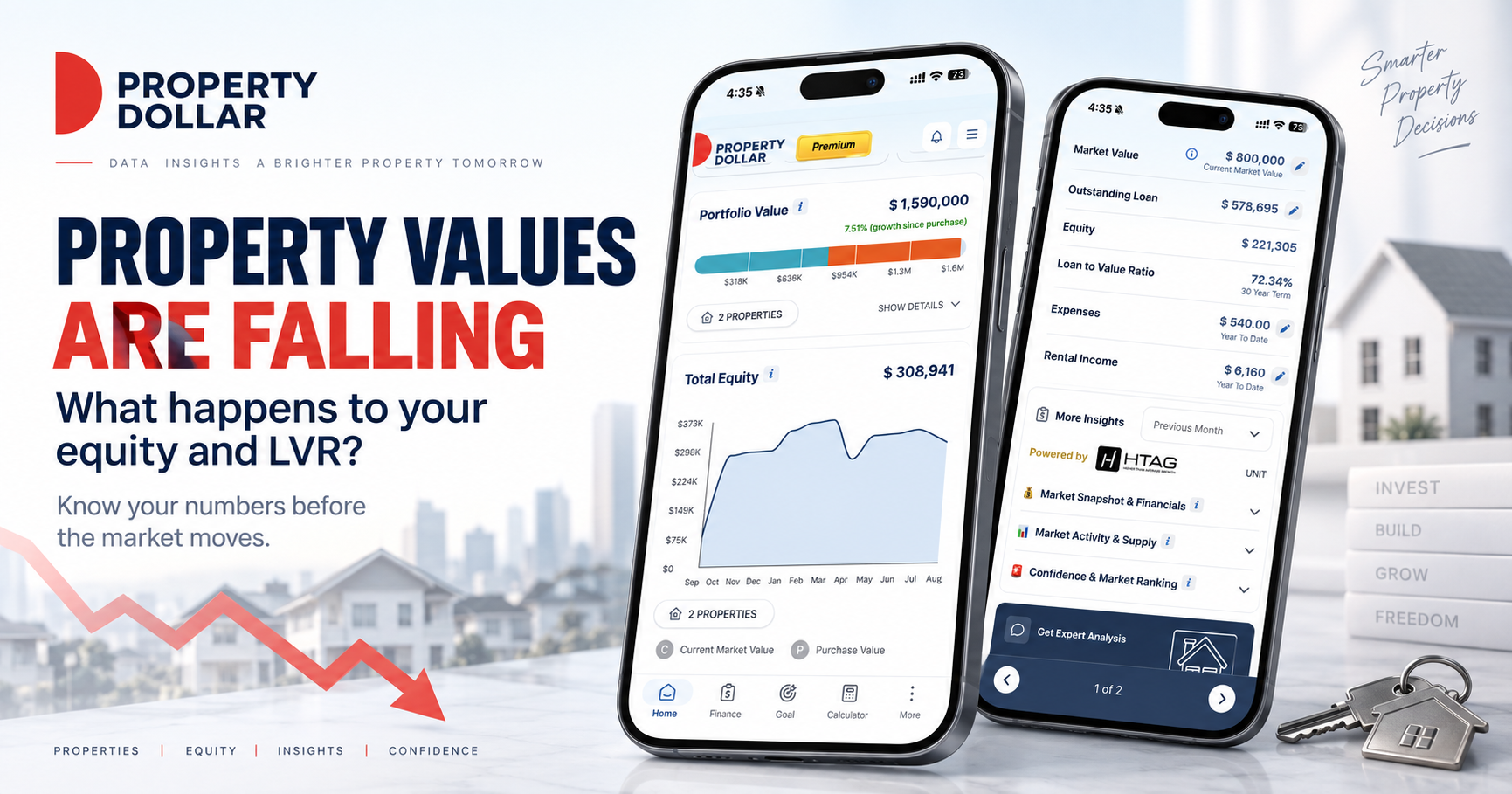
Property Dollar is built to help Australian property owners see the relationship between their properties and their debt in one place.
Rather than treating a valuation as an isolated number, Property Dollar helps bring together property values, loan balances, equity, LVR, expenses and cash flow so you can understand the wider portfolio position.
That visibility can help you identify the questions worth discussing with your broker, accountant, financial adviser or other relevant professional.
Because when markets move, the most useful question often isn’t:
“What is my property worth?”
It’s:
“What has that change done to my overall position?”
Know what you own. Know what you owe.
Markets move.
Property values change.
Loan balances change.
Equity changes.
LVR changes.
The more properties you own, the harder those relationships become to track manually.
Property Dollar helps bring together property values, loan balances, equity, LVR, expenses and cash flow so you can understand the wider portfolio position.
Explore how Property Dollar helps property investors track their portfolio in one place.
Have questions about Property Dollar, subscriptions, property data or how the app works? Visit the Property Dollar FAQ.
General information only. Property values are estimates and may differ from lender valuations or sale prices. Property Dollar does not provide financial, credit, tax or investment advice. Consider your circumstances and seek appropriate professional advice before making financial or property decisions.
FAQ
What happens to my equity if my property value falls?
If your loan balance remains unchanged, a fall in property value reduces your mathematical equity dollar-for-dollar. For example, if a $900,000 property with a $630,000 loan falls to $855,000, equity falls from $270,000 to $225,000.
Does my LVR increase when property prices fall?
Yes, if your loan balance remains broadly unchanged. Because LVR divides the loan balance by the property's value, a lower property value produces a higher LVR.
Can my equity fall faster than my property value?
Yes. Leverage means percentage changes in property value can produce much larger percentage changes in the owner's equity. In the example above, a 5% property-value decline reduces equity by about 16.7%.
Is equity the same as usable equity?
No. Equity is the difference between property value and debt. The amount a lender may allow you to access depends on its valuation, LVR limits, serviceability assessment, lending policy and your circumstances.
What is negative equity?
Negative equity occurs when the amount owed against a property exceeds its value.
Does a lower online property estimate mean my bank will use the same value?
Not necessarily. Automated estimates, agent appraisals and lender valuations can differ. A lender determines the valuation methodology it will accept for a particular lending decision.
How often should property investors check equity and LVR?
There is no universal required frequency. However, checking them together when values, loan balances, interest rates or borrowing plans change can give investors a clearer picture of their current position.