Two Buyers, Same Suburb, Different Valuations
- August 24, 2026
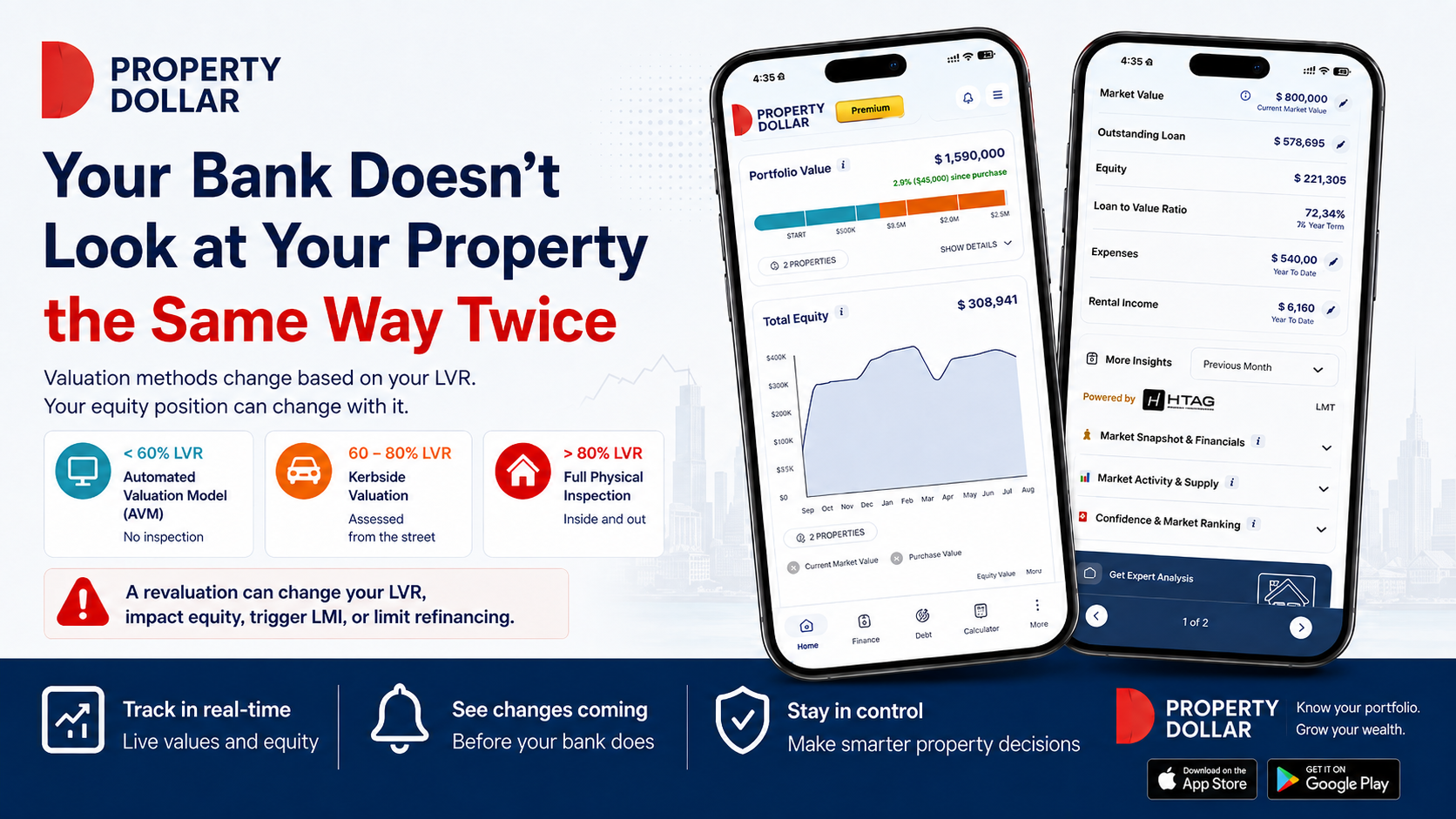
Your Bank Doesn’t Look at Your Property the Same Way Twice
The valuation your lender relies on isn’t a fixed, neutral process; it’s a decision tree, and which branch you land on is decided almost entirely by your loan-to-value ratio at the time. Borrowers under 60% LVR typically get an automated valuation model (AVM), a computer-generated estimate built from sales data and algorithms, with no human ever setting foot in the property. Borrowers between 60% and 80% LVR usually get a kerbside valuation, a valuer driving past and assessing from the street. Only borrowers above 80% LVR, or properties considered unique, high-value or hard to assess remotely, get a full physical inspection.
That tiering exists to save lenders time and money on loans they consider lower-risk. It also means two investors holding what looks, on paper, like an identical position, same suburb, similar property, similar loan balance, can have their equity assessed through two completely different methods, and get two different answers, for reasons that have nothing to do with the property itself.
Why the valuation method itself is a variable
An AVM is fast and cheap because it doesn’t see the property. It infers value from comparable sales, land size, and recorded features in a database. That works reasonably well for standard, cookie-cutter stock in areas with plenty of recent comparable sales. It works considerably worse for anything the model can’t easily categorise: an unrenovated property that still shows old fixtures in the last recorded sale data, a unique layout, a small or thin market with few recent comparables, or a property that’s had undocumented improvements. In those cases, AVMs have a documented tendency to misprice, in both directions, because the model is working from what was last recorded, not what’s actually standing on the block today.
A kerbside valuation adds a human judgement call, but one made from the street, so it captures obvious condition and street appeal while still missing everything inside the property, renovations, damage, layout changes. Only a full inspection actually accounts for the property’s real, current condition. The point isn’t that any one method is wrong, each is calibrated to the risk level it’s assigned to, it’s that the method applied to your property is a function of your LVR band, not of how confident anyone actually is in the number it produces.
Where this becomes a real problem: the revaluation, not the purchase
At purchase, this mostly sorts itself out because the contract price anchors expectations and most lenders build in a buffer. The sharper edge shows up later, at refinance, equity release, or any point your lender revalues the property off-cycle. If a softening market pushes your property’s estimated value down and an AVM is the method applied, you have no ability to point out that the kitchen was renovated last year or that the last three comparable sales the model used were distressed sales, because there’s no valuer to tell. A kerbside or desktop valuation in a falling market, where recent comparable sales are thinner and more likely to include forced or discounted sales, can land conservatively for reasons a full inspection might have corrected.
The mechanical consequence is direct: if a revaluation lowers your assessed property value while your loan balance stays the same, your LVR rises. Push past 80% LVR and you can be into Lenders Mortgage Insurance territory on a loan that never previously required it, an unbudgeted cost that can run into five figures, or you can find a planned equity release shrinks or disappears because the number it was calculated against just moved under you.
This is the part most property content skips: gross yield, purchase price, even net cash flow, are numbers you can see and calculate yourself. The valuation method applied to your loan isn’t disclosed upfront, isn’t something you choose, and isn’t visible until a revaluation event forces it into view, usually at the exact moment, refinancing, drawing equity, market softening, when you’d most like it to work in your favour.
What actually reduces the exposure
You can’t choose your lender’s valuation method, it’s set by policy and your LVR band. But two things are within an investor’s control. First, keeping a genuine buffer below the 80% LVR threshold matters more in a softening market than in a rising one, because it’s the difference between absorbing a conservative AVM estimate and being pushed into LMI or a stalled equity release by one. Second, and less obvious: if you know a revaluation is coming and your property has had improvements an automated model wouldn’t know about, from a renovation to a change in comparable sales activity nearby, it’s worth proactively flagging that to your lender or broker before the valuation runs, not after a low number arrives and you’re arguing to overturn it.
Property Dollar’s real-time LVR and equity tracking exists precisely for the gap this creates: most investors only find out their actual LVR position when a lender recalculates it for them, at a moment the investor didn’t choose and the lender’s method didn’t disclose. Tracking your live loan balance and valuation trend against your own numbers, continuously rather than only at the moment a bank forces the question, means the revaluation moment stops being a surprise and starts being something you can see coming.
The bottom line
The number on your loan statement feels objective. The process behind it isn’t, it’s a risk-tiered system where your LVR decides how closely anyone actually looks at your property, and that choice of method can move your equity position independent of anything that’s actually changed on the ground. Knowing which tier you sit in, and staying aware of how close you are to the next one, is a smaller, quieter piece of risk management than watching the cash rate, but it’s one that only shows up when it’s too late to do much about it.
Sources: Home Loan Experts, Desktop Valuation Guide: How Lenders Value Property Online, 2026 · Mozo, Property valuation: what is it and how much does it cost in Australia, 2026 · hovr, Bank Property Valuation Too Low? What It Means and What to Do, 2026 · Duotax, Bank Valuation Lower Than Purchase Price, 2026 · Capital Properties, Desktop, Kerbside & Full Property Valuations – What’s What, 2026