An apartment can look perfect on inspection. The kitchen is new. The rent estimate is attractive. The advertised strata levies look manageable.
But what happens when the building needs a new lift, the roof is leaking, or owners are asked to fund repairs that were not properly budgeted?
The listing tells you about the apartment. The strata report helps you understand the building and the financial obligations that come with it.In NSW, recent strata law reforms make this an especially useful time to revisit what investors should check.
Reforms commencing on 1 April 2026 strengthened capital works planning and disclosure. Further changes commenced on 1 October 2026, including annual training requirements for many strata committee members. NSW Fair Trading explains the reforms.
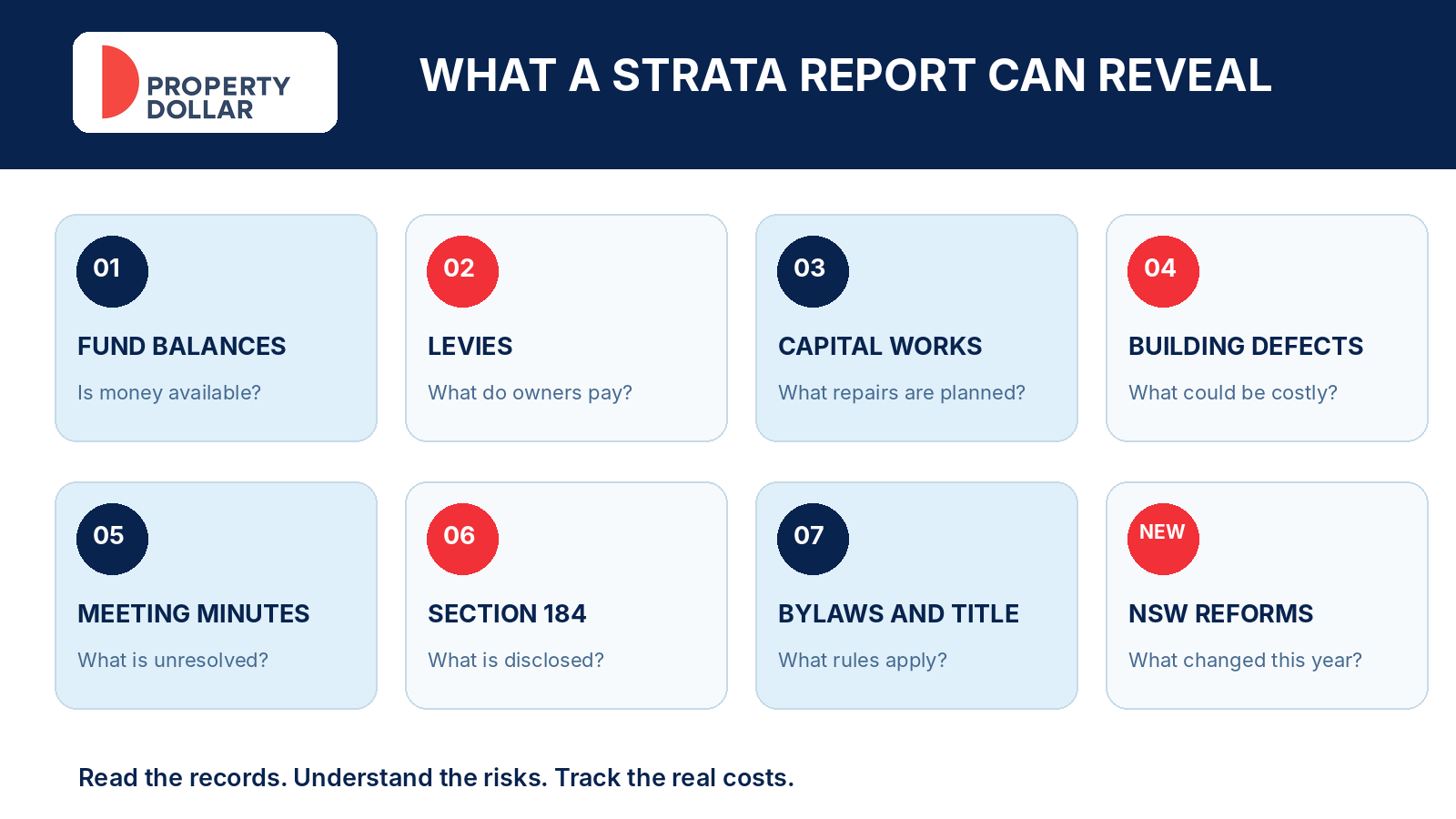
Here are seven checks worth making before committing to a strata apartment, townhouse or villa.
What is a strata report in NSW?
A strata report is a review of records held by the owners corporation for a strata scheme. It can reveal financial statements, levies, building defects, planned repairs, insurance information, meeting minutes and disputes.
It is not the same as a physical building inspection. A building inspector examines the condition of the property. A strata search examines records about how the building is managed and what owners may have to fund. The NSW Government recommends both before purchasing a strata property.
See the official NSW guide to buying strata property.
A strata report also cannot guarantee that every future defect or expense has already been identified. Treat it as an essential part of due diligence, not a substitute for professional advice.
The seven strata report checks every apartment investor should make
1. Compare the administrative fund and capital works fund
NSW strata schemes generally operate two funds. The administrative fund pays regular expenses such as cleaning, common area utilities, insurance and routine upkeep.
The capital works fund, sometimes called the sinking fund, is used for major repairs and replacement of shared assets.
Do not judge a scheme simply by the amount in its bank account. Compare fund balances with expected spending, the age of the building and the works already scheduled.
A healthy looking balance may still be inadequate if expensive repairs are approaching.
The NSW Government explains how strata levies and funds operate.
2. Check ordinary levies, arrears and proposed special levies
Ask what your particular lot pays each quarter, whether levies have recently increased, and whether further increases have been discussed. Read the budget and the most recent meeting minutes.
A special levy is an additional contribution approved by the owners corporation to fund a particular expense or shortfall. It can create a substantial cash requirement even when the regular quarterly levy appears affordable. NSW Fair Trading explains special levies.
Look for arrears across the scheme as well. Unpaid levies can affect cash available for repairs. A high arrears balance does not automatically mean the building is poorly managed, but it warrants an explanation.
Investor question: If a special levy were approved next year, could your portfolio cash flow absorb it without relying on an optimistic rent increase?
3. Read the 10 year capital works fund plan
The capital works plan forecasts major common property expenditure and the funding expected to support it. Look for roofs, waterproofing, balconies, lifts, fire systems, painting and major plant replacement.
Compare three things: the cost of upcoming works, the planned contributions, and the current capital works fund balance. If a major project is approaching with no credible funding pathway, ask how it will be paid for.
From 1 April 2026, NSW schemes must use a prescribed standard form when preparing a new 10 year capital works fund plan or revising or replacing an existing one. An existing plan does not need to be converted immediately if it is not yet due for revision or replacement. NSW Government guidance on the 2026 changes.
A plan is a forecast, not a promise. Ask whether estimates are current and whether major items have been independently assessed.
4. Investigate defects, maintenance and insurance
Look for recurring references to water ingress, concrete cracking, balcony issues, fire safety work, lift failures or repeated repair quotations. One minor issue may be manageable. A pattern of unresolved defects across several meetings deserves closer investigation.
Check whether insurance is current, what is covered by the strata policy, and whether there are unusually large excesses or exclusions. Owners may still need their own landlord or contents cover depending on the property and circumstances.
Ask a qualified building inspector about physical defects, and ask your solicitor or conveyancer about any legal or contractual implications. A strata report alone does not establish the cost or responsibility for every repair.
5. Read meeting minutes for disputes and decisions not yet funded
Annual general meeting minutes and strata committee minutes often reveal issues before they appear in a formal levy notice.
Look for motions about major repairs, contractor disputes, litigation, insurance claims, proposed loans, budget shortfalls and recurring complaints. Note which motions passed, which were deferred and which remain unresolved.
Do not assume that a problem disappears because it is missing from the latest meeting. Ask for a suitable history of minutes and related documents, and seek clarification on gaps. NSW strata schemes must retain specified records, including meeting records and financial information, generally for seven years. See NSW record keeping requirements.
6. Obtain the Section 184 certificate and check embedded networks
A NSW Section 184 strata information certificate provides prescribed information about a lot and its scheme, including levies and other scheme details. It is a useful snapshot, but it does not replace a full strata records review.
The April 2026 reforms expanded required certificate information to include exclusive supply networks, often called embedded networks, along with certain orders or compliance action and recent and upcoming meetings. An embedded network may affect how electricity, gas, hot water or other services are supplied and charged. Read the official NSW certificate guidance.
Ask whether the building has an embedded network, how charges are set, whether alternative suppliers are available and whether any contract terms could affect the ongoing cost of ownership.
7. Check bylaws, unit entitlement and what you actually own
A car space, storage cage, balcony or courtyard may look like part of the apartment, but legal ownership and exclusive use rights depend on the strata plan and relevant documents.
Check the unit entitlement because it influences the share of common property expenses attributable to the lot. Review bylaws affecting renovations, parking, pets, noise and other uses relevant to your investment strategy.
Ask your conveyancer to explain any unusual title arrangements, easements or restrictions. Never rely solely on the floor plan or sales brochure.
Save this guide: Download the seven check strata report checklist and use it with your conveyancer or strata search professional.
What changed in NSW strata law during 2026?
Two commencement dates matter for investors reviewing NSW strata records.
1 April 2026: New and revised 10 year capital works fund plans use a prescribed form. Initial maintenance schedules for new schemes also use a prescribed form. For new multistorey schemes, independent surveyor review and certification requirements apply to initial maintenance schedules and initial levy estimates. Section 184 certificates now contain additional disclosures.
1 October 2026: Many new and returning strata committee members must complete free annual training within three months of appointment. Two lot schemes are exempt from strata annual reporting, and some committee training exemptions also apply.
These changes improve the framework for planning and disclosure. They do not guarantee that a building has sufficient funds or no defects. For precise scope and exemptions, consult NSW Fair Trading’s current reform guide.
Example: two apartments at the same price can have different holding costs
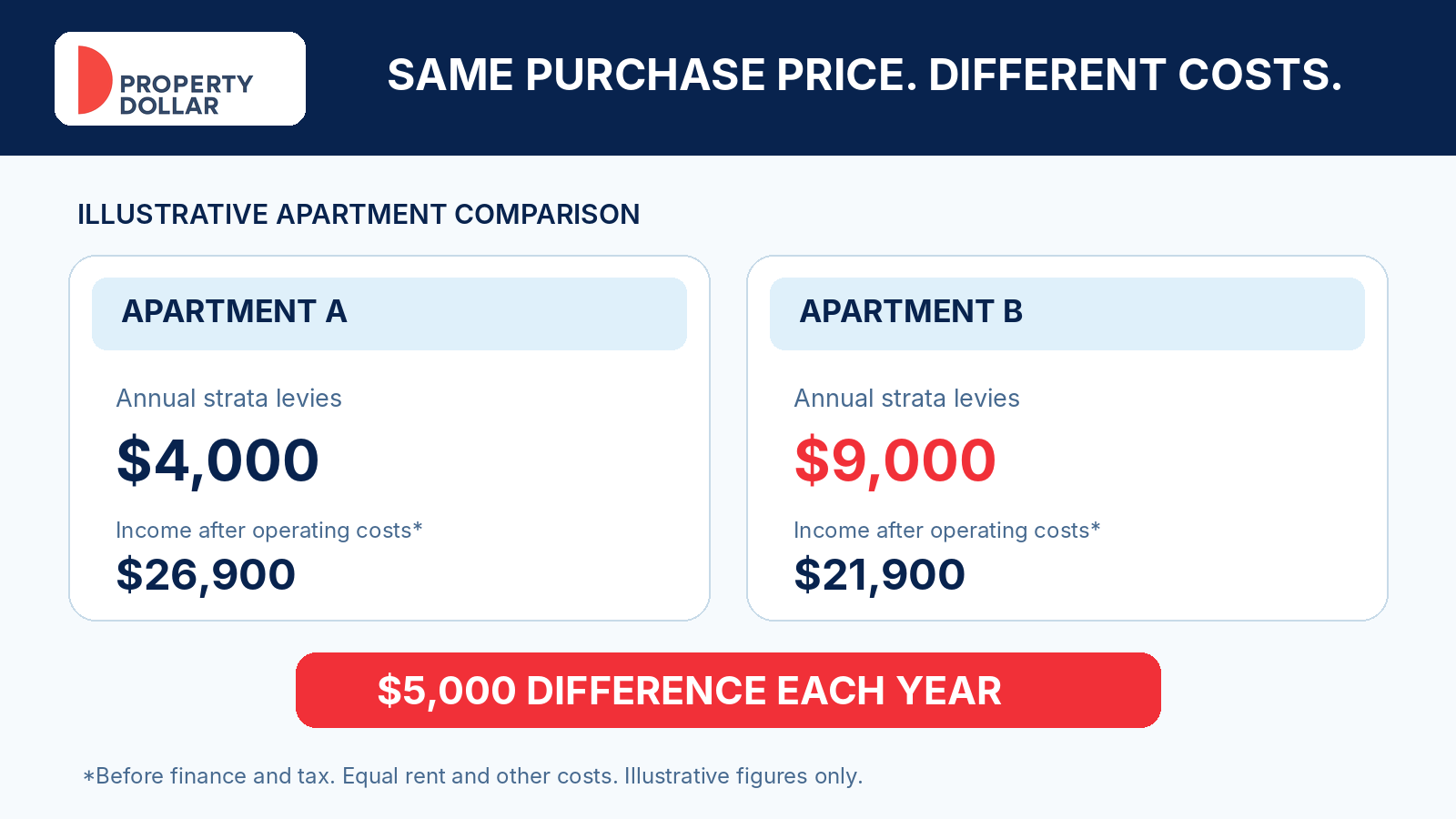
Consider two hypothetical investment apartments, each purchased for $780,000 and each earning $700 per week in gross rent. That is $36,400 in annual rent before expenses.
Assume each property has $5,500 of other annual operating expenses, comprising management, council and water charges, landlord insurance and a maintenance allowance. For simplicity, the example excludes finance costs, tax, vacancy and any one off purchase expenses.
| Illustrative annual amount | Apartment A | Apartment B |
|---|---|---|
| Gross rent | $36,400 | $36,400 |
| Strata levies | $4,000 | $9,000 |
| Other operating expenses | $5,500 | $5,500 |
| Income after operating expenses | $26,900 | $21,900 |
Apartment B produces $5,000 less each year before financing and tax, despite having the same purchase price and rent. If Apartment B also faces a separate $15,000 special levy, that creates an additional cash requirement in the year it is payable. It should not be confused with an ordinary recurring expense.
This is why comparing advertised rental yields without reviewing holding costs can mislead. For a broader framework, read How Do Professional Investors Compare Properties? and Has Your Rental Income Gone Up? Check Your Yield Before You Celebrate.
How to use your strata findings in a portfolio plan
Before making an offer, convert the report into a working financial picture. Record the regular levy, the amount and timing of any proposed special levy, and a reasonable allowance for other ownership costs. Then test whether the investment still fits your budget under less favourable assumptions.
Our guide to stress testing investment property cash flow explains how to model changes in rates, rent, vacancy and expenses. The companion article on property cash flow blind spots explains why irregular bills can be missed.
After purchase, keep the strata report, Section 184 certificate, capital works plan, levy notices and relevant correspondence together. Review them when new budgets or major works are proposed. The same discipline is useful when assessing refinancing or future acquisitions, as explained in How Do Property Tracking Apps Help Plan Refinancing and New Purchases?.
How Property Dollar helps you keep the numbers together
Property Dollar is designed to help Australian property owners see their portfolio information in one place. You can record property related expenses, keep important property documents organised and review cash flow alongside property values, loans, equity and LVR.
For a strata property, that means you can keep levy notices and supporting records accessible and include relevant ownership costs in your financial picture. Property Dollar does not prepare or certify strata reports, inspect buildings, verify future levies or provide legal advice.
Know the building before you buy. Know the numbers after you own it. Download the strata report checklist and explore Property Dollar and start tracking your property portfolio at Property Dollar. Consider available premium features if you need additional portfolio tools.
FAQ
What is included in a strata report in NSW?
A strata search report generally examines available owners corporation records, including financial statements, levy information, insurance, meeting minutes, building issues, planned works and disputes. Coverage depends on the records available and the scope of the search.
Is a strata report compulsory before buying an apartment?
A buyer is not generally required to commission a professional strata search report, but the NSW Government recommends obtaining one and a building inspection before buying. Your solicitor or conveyancer can advise on the documents and due diligence appropriate to your purchase.
What is the difference between strata levies and special levies?
Regular strata levies fund ordinary scheme costs and contributions to capital works. A special levy is an additional contribution approved to cover a specific funding need, such as major repairs or a shortfall.
What is a capital works fund?
It is the fund used for major common property repairs and replacements. The 10 year capital works plan forecasts likely future spending and how the scheme intends to fund it.
Does a low strata levy mean an apartment is a good investment?
Not necessarily. A low levy may reflect a simple building with modest costs, or it may indicate insufficient provision for future maintenance. Compare the budget, fund balances, capital works plan and condition of the building.
What is a Section 184 certificate in NSW?
It is a prescribed information certificate about a strata lot and scheme. It includes levy information and other required disclosures. Since 1 April 2026, additional disclosures include embedded networks and certain compliance and meeting information.
Can a strata report reveal future special levies?
It may identify proposed works, funding gaps, resolutions and discussions that suggest additional levies could be considered. It cannot reliably predict every future levy or unforeseen repair.
Can Property Dollar analyse a strata report for me?
Property Dollar can help organise property documents and track relevant expenses and portfolio figures. It does not replace a professional strata search, building inspection or legal review.
Important: This article provides general information only, primarily about NSW strata requirements as at 12 October 2026. Rules differ across Australian states and territories. It is not legal, tax, financial or credit advice. Seek advice from appropriately qualified professionals for your circumstances.