Do You Know Your Exact Equity Position Right Now? (Most Investors Don’t)
- February 26, 2026
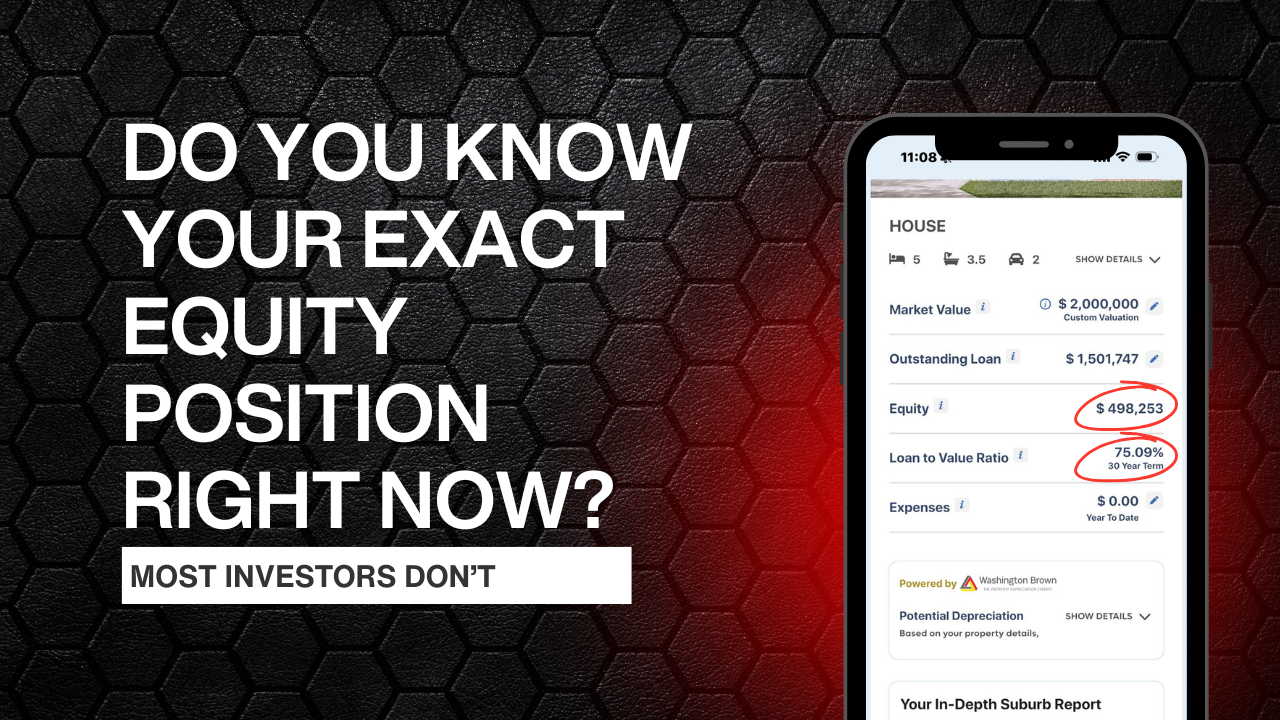
Important: This article is for informational purposes only and does not constitute financial advice. Always consult with a qualified financial advisor before making investment decisions.
Here’s a question that should have a simple answer: Do you know your exact equity position right now?
Not approximately. Not “around $200,000.” Not “probably similar to last time I checked.”
Exactly.
Can you tell me, without looking anything up, what your current loan balance was this morning? Which of your properties has the most available equity today? What’s your portfolio-wide loan-to-value ratio as of this moment?
If you’re hesitating, you’re not alone. Most property investors, even successful ones with multiple properties, are operating on estimates, educated guesses, and data that’s weeks or months out of date. They’re making six-figure investment decisions based on approximations.
In a market where opportunities appear and disappear in days, that uncertainty is expensive.
Why Most Investors Don’t Know Their Equity
The reason most investors can’t answer “what’s my exact equity position?” isn’t laziness or carelessness. It’s that the traditional system makes knowing genuinely difficult.
The Recency Problem
Even if you spent two hours yesterday gathering loan balances from all your lenders and calculating equity across your portfolio, that data started becoming stale the moment you finished. Your loan balance changed with your last repayment. Interest accrued overnight. The numbers you “know” are already historical data, not current facts.
This creates a perpetual recency problem. No matter when you last checked, you’re working with outdated information. And the further you get from your last update, the less confident you can be in your numbers.
The Multi-Property Complexity
When you own one investment property with one loan, tracking equity is straightforward enough. You might not do it often, but the process is manageable.
Add a second property with a different lender, and complexity doubles. Three properties across three lenders? The effort triples. By the time you’re managing five or six properties, which isn’t unusual for committed investors, the task of gathering current loan data from multiple banking portals becomes something you actively avoid.
Each additional property multiplies the cognitive friction of staying current.
The Effort Barrier
Let’s be honest about what “checking your equity” actually involves:
- Remembering passwords for multiple lender portals
- Navigating different banking interfaces
- Finding where each bank displays loan balances (they’re never in the same place)
- Dealing with security verifications and two-factor authentication
- Recording the data somewhere
- Updating your tracking spreadsheet
- Calculating equity based on property valuations
- Double-checking your math
For a multi-property portfolio, this is easily a two-hour project. That’s two hours most investors simply don’t have, so they keep postponing it. “I’ll update everything next weekend.” Next weekend comes, and there’s something more urgent to do.
The effort barrier is the primary reason investors operate on stale data.
The “Good Enough” Mindset
Faced with this effort barrier, investors rationalise: “I checked three months ago. The numbers probably haven’t changed that much. This is good enough for now.”
And in some contexts, that might be acceptable. If you’re not actively looking to invest, approximate knowledge might suffice.
But here’s what happens: an opportunity appears. Your broker calls with a property that fits your criteria. Suddenly, “good enough” isn’t good enough anymore. You need actual numbers. And now you’re in a rush, trying to gather data while the opportunity clock is ticking.
The Reality: Most Check 1-2 Times Yearly
Research on investor behaviour shows that most property investors comprehensively check their equity position only once or twice annually. Yet they’re making decisions about refinancing, purchasing, or renovating far more frequently.
This creates a fundamental mismatch: monthly or quarterly decisions based on semi-annual data.
Professional investors recognise this as untenable. You can’t make good decisions without good data. But the effort required to maintain current data using traditional methods is so high that even professionals struggle with it.
The Hidden Dangers of Equity Uncertainty
Operating without precise knowledge of your equity position isn’t just inconvenient—it creates real risks and costs.
Missed Opportunities You’ll Never Know About
This is perhaps the most insidious cost: the opportunities you passed on because you “didn’t think” you had enough equity.
Imagine this scenario: A property comes on the market in a suburb you’ve been watching. It fits your investment criteria. You do a quick mental calculation based on equity numbers you remember from four months ago and conclude you’re probably $30,000 short of the deposit you’d need.
You don’t pursue it. The property sells. Six weeks later, when you finally update your numbers for tax purposes, you discover you actually had $45,000 more equity than you thought. You had enough. You just didn’t know it.
How often does this happen? You’ll never know, because you don’t know what you missed.
Delayed Decisions While Gathering Data
Even when you know an opportunity requires accurate data, the time needed to gather that data creates costly delays.
Your broker calls on Tuesday with a property. You say, “let me check my numbers and get back to you.” By the time you’ve logged into three different bank portals, updated your spreadsheet, and confirmed your equity position on Thursday, two other investors have already made offers.
In competitive markets, speed is a genuine advantage. Investors who can answer “what’s my equity position?” in seconds rather than days have a structural edge.
Over-Borrowing From Underestimating Equity
Here’s a scenario that costs investors real money: You’re planning a renovation. You estimate you have $80,000 in available equity. To fund a $100,000 renovation, you figure you’ll need to come up with $20,000 in cash or take on higher-LVR borrowing.
What you don’t realize is that you actually have $115,000 in equity. If you knew that, you could fund the entire renovation from equity at lower interest rates, keeping your cash for other opportunities.
Uncertainty doesn’t just cause missed opportunities—it leads to suboptimal financing decisions that cost money every month.
Refinancing Blindness
Refinancing is most beneficial when your LVR has improved enough to access better rates or remove the lender’s mortgage insurance. But if you don’t know your current LVR, you don’t know when you’ve crossed these thresholds.
Many investors continue paying higher rates long after they’ve qualified for better terms, simply because they weren’t tracking their LVR closely enough to recognise the opportunity.
Portfolio Imbalance
When you have multiple properties, strategic leverage means drawing equity from the right property. The one with the best LVR? The one with the lowest interest rate? The one that’s appreciated most?
Without current data on all properties, you can’t make this strategic choice. You’re left leveraging whichever property you checked most recently, which might not be optimal.
The $80,000 Discovery
Here’s a real scenario from a Property Dollar user: An investor with three properties was planning his next purchase. Based on numbers from his last annual review, he calculated he had about $140,000 in available equity.
When he connected Open Banking and saw real-time data, he discovered he actually had $223,000 in equity. One property had appreciated significantly more than he realised, and his principal payments over ten months had reduced his debt more than expected.
That $83,000 difference completely changed his investment strategy. He upgraded his target property type, purchased sooner than planned, and positioned himself for better capital growth.
How many investors are walking around with similar blind spots?
What “Knowing Your Equity” Actually Means
There’s a significant difference between approximate knowledge and precise knowledge. Let’s be specific about what knowing your equity actually means.
Most investors operate at the approximate level:
- “I have roughly $200,000 in equity across my properties”
- “My LVR is probably around 70%”
- “I could probably borrow another $150,000 or so”
Professional investors operate at the precise level:
- “Property A (Smith Street) has $87,340 in available equity at 67.2% LVR”
- “Property B (Jones Avenue) has $124,580 in available equity at 71.8% LVR”
- “Combined portfolio LVR is 68.9% with $211,920 in total available equity”
Notice the difference? Precision enables strategy in ways approximation cannot.
Why Precision Matters for Broker Conversations
When you speak with your mortgage broker, precision changes the conversation entirely.
Approximate version: “I think I have around $200k in equity. Can you see what I can borrow?”
Precise version: “I have $211,920 in available equity across two properties. Property A is at 67.2% LVR, Property B at 71.8%. I’m looking to borrow $180,000 for my next purchase.”
Which conversation leads to faster, better outcomes?
Why Precision Matters for Investment Timing
Investment timing often comes down to: “Can I act now, or do I need to wait?”
With approximate knowledge, you’re conservative. You wait until you’re certain you have enough, which means you’re probably waiting longer than necessary.
With precise knowledge, you know exactly when you’ve crossed the threshold. The day you have enough equity is the day you can act.
Why Precision Matters for Risk Management
Risk management requires understanding your true exposure. If you think your portfolio-wide LVR is 75% but it’s actually 81%, you’re carrying more risk than you realise.
Conversely, if you think you’re at 80% but you’re actually at 72%, you’re being more conservative than necessary, potentially missing growth opportunities.
You can’t manage risk you can’t measure accurately.
Professional Investors vs. Amateurs: Precision vs. Approximation
Here’s a fundamental dividing line between professional property investors and amateurs: professionals demand precise data.
An amateur says “I think I have about $200k in equity.”
A professional says “I know I have $211,920 in equity as of this morning.”
This isn’t about being detail-obsessed—it’s about having the foundation for good decisions. Every significant investment decision should be based on facts, not estimates.
The Investor Mindset Shift
Consider how you’d react to these statements:
“I run a business, but I haven’t looked at my financials in three months. I assume revenue is fine.”
“I invest in the stock market, but I don’t check current prices. I just remember what I paid.”
“I own commercial real estate, but I haven’t verified my rental income lately. It’s probably about the same.”
You’d recognize these as absurd. No serious business owner, stock investor, or commercial property investor would operate this way.
Yet somehow, residential property investors accept “I checked my equity position six months ago” as normal.
You Wouldn’t Run a Business on Stale Financials
Imagine telling your accountant: “I’ll send you last year’s bank statements. This year’s are probably similar.”
No business owner would do this. Financial data must be current to be useful. Decisions made on outdated financials are dangerous.
Your property portfolio is a business—often a multi-million-dollar business. It deserves the same data discipline as any other business venture.
You Wouldn’t Invest in Stocks Without Current Prices
Stock investors check their portfolio values constantly. They know exactly what their holdings are worth right now. They make buy/sell decisions based on current market data.
Property investors often check their equity position less frequently than stock investors check their portfolio, despite property investments being larger and less liquid.
Why the double standard?
Professional Investors Demand Real-Time Data
Talk to investors managing significant portfolios, and you’ll notice a pattern: they have systems that provide current data continuously.
This isn’t because they’re obsessive. It’s because they understand that data quality determines decision quality. Making decisions based on outdated information is simply accepting unnecessary risk.
Professional standards don’t allow for “I think” or “probably around” or “last time I checked.” Professional standards demand “I know” and “as of today.”
The Confidence That Comes From Certainty
There’s a psychological dimension to precise knowledge that’s hard to quantify but deeply valuable.
When you know your exact equity position, you approach opportunities with confidence. You can evaluate properties without the nagging uncertainty: “But can I actually afford this?”
When you’re operating on estimates, there’s always doubt. “I think I can do this, but I should probably verify my numbers first…” That hesitation creates friction in every investment decision.
Certainty enables decisiveness. Uncertainty breeds hesitation.
How Real-Time Equity Tracking Changes Everything
Let’s contrast two investor experiences: before and after real-time equity visibility.
Before: The Uncertainty Cycle
Monday: “I should probably check my equity position soon. I haven’t looked in a while.”
Tuesday: Too busy. Maybe this weekend.
Wednesday: Broker calls with potential property. “Let me check my numbers and get back to you.”
Thursday: Finally log into first bank portal. Password expired. Reset password. Get into account. Find the loan balance. Write it down.
Friday: Log into second lender. Two-factor authentication. Find balance. Update spreadsheet. Calculate equity. Math doesn’t look right. Double-check.
Saturday: Call broker back with numbers. Property already has two offers.
Sunday: “I really need to keep my equity tracking more current…”
This cycle repeats endlessly. The intention is there, but the friction is too high.
After: Real-Time Visibility
Monday: Open Property Dollar. See exact equity across all properties instantly. Make note that Property B has crossed 70% LVR—refinancing might be worth exploring.
Wednesday: Broker calls with property. Open app during phone call. “Yes, I have $187,000 in available equity across Properties A and C. Property A at 68% LVR would be the better leverage source. I can commit today if the numbers work.”
Thursday: Make offer on property with confidence in exactly what you can borrow.
Notice the difference? The entire decision timeline compressed from days to minutes. The uncertainty disappeared entirely. The conversation with the broker became strategic rather than tentative.
The Speed Advantage in Competitive Markets
In markets where desirable properties receive multiple offers within days, speed creates real advantage.
The investor who can evaluate their capacity instantly and make decisions confidently will secure properties that others are still “checking numbers” on.
In competitive markets, this is often the difference between building your portfolio and watching others build theirs.
Confidence in Broker and Lender Conversations
When you’re speaking with brokers, lenders, or financial advisors, the quality of your data shapes the quality of advice you receive.
“I think I have around $200k in equity” leads to general, conservative advice.
“I have $211,920 in available equity; Property A at 67.2% LVR, Property B at 71.8%” leads to specific, strategic advice tailored to your actual situation.
Financial professionals respond to precision with precision.
Ability to Act on Opportunities Immediately
Property opportunities don’t wait for you to gather data.
An off-market deal comes to your attention. A motivated seller needs to move quickly. A property comes on the market underpriced.
These situations reward investors who can act decisively. “Let me check my numbers” means you’re already behind investors who know their numbers.
Real-time equity visibility transforms you from a reactive investor (waiting until you have time to check) to a proactive investor (always ready when opportunity appears).
No More “Let Me Check and Get Back to You”
This phrase—”let me check and get back to you”—is the hallmark of uncertain investors.
It’s not that checking is wrong. It’s that needing to check every time that indicates you’re not operating with current data.
When you have real-time visibility, “let me check” becomes “here’s my exact position.” The difference in how you’re perceived—and how quickly you can move—is significant.
Portfolio-Wide Visibility Changes Strategic Thinking
Perhaps the most profound change is how seeing your entire portfolio in one view changes your strategic thinking.
When you’re checking properties individually, you think about them individually.
When you see everything together—total equity, portfolio LVR, individual property positions—you start thinking strategically about the portfolio as a whole.
Which property has the best leverage potential? Which needs attention? Where should your next investment focus? These portfolio-level questions only become clear with portfolio-level visibility.
Enter Property Dollar’s Open Banking
This is where Property Dollar’s Open Banking integration changes the game for property investors.
Rather than manually tracking loan balances across multiple lenders, Open Banking connects directly to your home loan accounts and retrieves current balance data automatically.
Here’s how it works:
Direct Connection to Home Loan Accounts
Property Dollar connects securely to your lenders. You authenticate once through each lender’s own secure system, granting Property Dollar permission to access your home loan data.
From that point forward, your loan balances update automatically in the background.
Automatic Loan Balance Updates
Every time you open Property Dollar, your loan balances are current. Not from last week, not from last month—from right now.
You don’t think about updating. You don’t log into anything. The system maintains current data continuously.
Combined With Real-Time Property Valuations
Property Dollar already provides real-time property valuations using market data. When you combine current property values with current loan balances, you get precise equity calculations automatically.
Property worth $850,000 today. Loan balance $567,000 today. Equity: $283,000. LVR: 66.7%.
These numbers update continuously without any effort from you.
See Exact LVR Across Your Entire Portfolio
For each property, you see:
- Current market value
- Current loan balance
- Available equity
- Current LVR
- How these numbers have changed over time
For your portfolio overall, you see:
- Total property value
- Total loan
- Total equity
- Portfolio-wide LVR
- Individual property comparisons
Everything you need to make informed decisions is visible in seconds.
Multi-Property Dashboard View
Whether you own two properties or ten, they’re all visible in one consolidated view.
No switching between apps. No logging into multiple portals. No maintaining separate spreadsheets.
One dashboard. Complete visibility. Always current.
One-Time Setup, Perpetual Accuracy
The initial setup takes about 10-15 minutes per lender. You authenticate, grant permission, and you’re done.
From that point forward, everything happens automatically. Your data stays current without any ongoing effort.
This is the automation that professional investors need: set it once, benefit continuously.
$9.99/Month for Always-Current Data
Property Dollar’s Open Banking feature is available in the premium tier at $9.99 per month.
Consider what you get for that investment:
- Never manually check loan balances again
- Always know your exact equity position
- Make decisions based on current data, not estimates
- Respond to opportunities instantly
- Portfolio-wide visibility in one dashboard
- Hours of time saved monthly
For investors serious about portfolio growth, this isn’t an expense—it’s infrastructure.
Real Investor Scenarios
Let’s look at how real-time equity visibility changes actual investor situations.